Styling
The Jhumka Guide: How to Wear India's Favourite Earring
The one earring shape that works with a wedding lehenga and a Monday kurta. Here is how to get it right at both ends.
Updated 3 min readRenu Ornaments
Why the jhumka survives everything
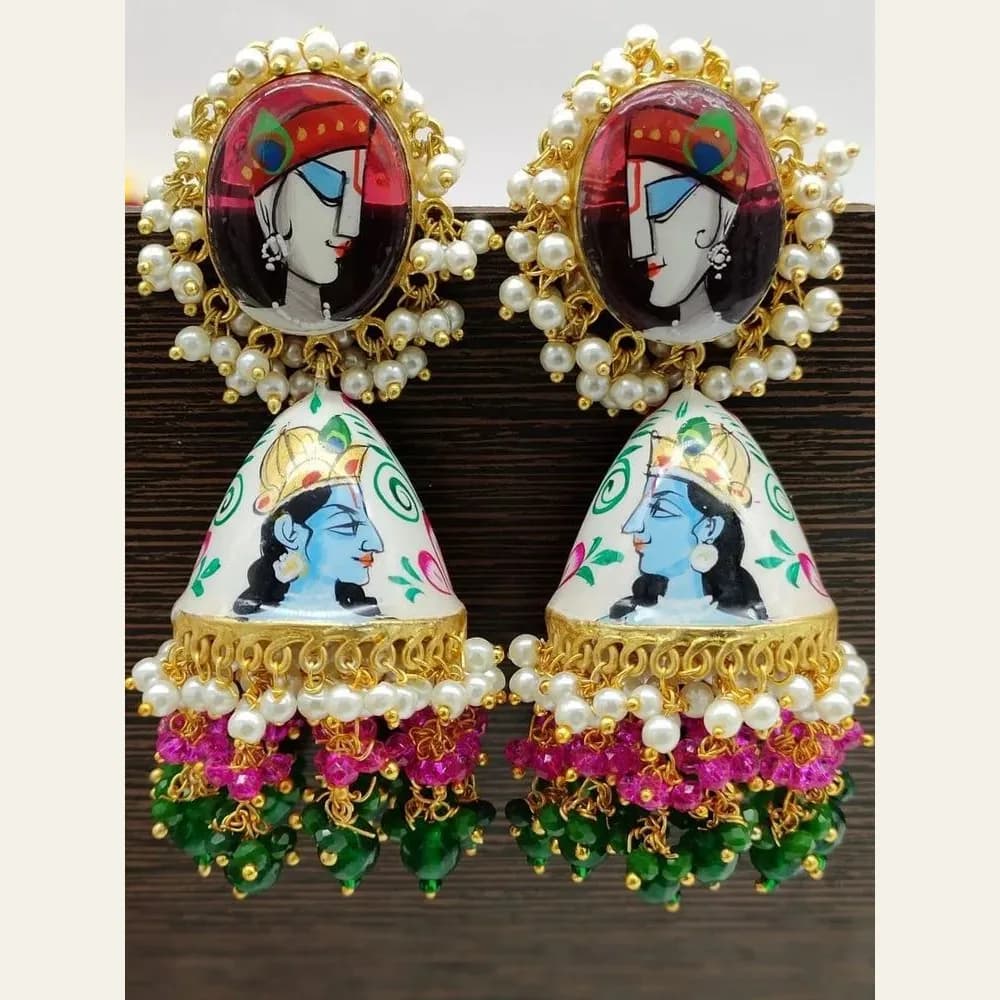
The jhumka — a bell or dome hanging from a stud, often with a fringe of beads or pearls along the rim — appears in temple sculpture, in Mughal miniatures, in 1970s film costume and in this week's Instagram. Very few designs work across that much time.
Part of the reason is structural: the dome hangs freely and swings, which catches the eye without needing to be large. Part is cultural: it is regionally universal in a way most Indian jewellery isn't, worn from Tamil Nadu to Punjab under different names and slightly different proportions.
Picking the size
| Size | Reads as | Best for |
|---|---|---|
| Small (under 2 cm) | Everyday, quiet | Office, daily wear, layering with a necklace |
| Medium (2–3.5 cm) | Festive but wearable | Family functions, festivals, dinners |
| Large (3.5 cm+) | Statement | Weddings, sangeet, receptions — with a bare neck |
One practical check before ordering: hold a ruler against your jaw. A jhumka that ends level with your jawline reads as balanced; one that hangs well below it reads as dramatic. Both are fine — just know which one you're buying.
A medium-large meenakari jhumka
Outfit pairings that work
Cotton or chanderi kurta
The most common combination in the country, and it works because the outfit is quiet and the earring isn't. Keep the neck bare, add a single bracelet, done.
Saree
Jhumkas with a saree want hair off the face. If the blouse is heavily worked, keep the jhumka simpler; if the blouse is plain, this is your moment for the largest pair you own.
Lehenga
A large jhumka can replace a necklace entirely with a lehenga, which is useful when the blouse is embroidered to the neck. Pair with a ring and nothing else.
Jeans and a plain shirt
Yes, genuinely. A medium jhumka with a white shirt is a standard Indian working-wardrobe combination. The rule is that the jhumka must be the only ethnic element — see Indo-Western styling.
The hair question
- Bun or updo — maximum visibility, best for large pairs.
- Half-up — the most flattering for medium jhumkas; keeps softness around the face.
- One side tucked — the low-effort fix that makes any pair visible.
- Loose and forward — the jhumka disappears. If this is your usual hair, buy for the swing and the sound, not the size.
Colour, without overthinking it
Meenakari enamel comes in jewel tones, and a common worry is whether green earrings can be worn with a pink outfit. In practice, multi-colour enamel behaves like a neutral: because it contains several colours, the eye reads it as ornament rather than as a colour that must match.
Two guidelines are enough. If the outfit is a single strong colour, pick enamel that contains that colour somewhere. If the outfit is multi-coloured or printed, choose gold-dominant enamel with less colour, so the earrings don't add a third pattern.
Frequently asked questions
Can jhumkas be worn every day?
Small and medium jhumkas, easily. Large statement pairs are better saved for occasions, mostly for comfort reasons over a long day.
How do I stop jhumkas from tugging on my ears?
Use a supportive ear-back — a plastic disc or a clear silicone back spreads the load. For heavier pairs, an ear-chain hooked into the hair takes the weight off the lobe entirely.
Do I need a matching necklace with jhumkas?
No, and with a large pair you actively shouldn't. A bare neck is the point — it gives the earring room.
Are meenakari jhumkas suitable for a wedding?
Yes. A gold-toned meenakari jhumka is entirely appropriate wedding-guest jewellery, and it photographs better under indoor lighting than most oxidised alternatives.
Shop this guide