Buying Guide
Mirror-Work and Thread Jewellery for Navratri: The Gujarati Garba Look
Abhla mirrors, braided thread and cowrie shells: jewellery from the same tradition as the chaniya choli, and how to wear and look after it.
Updated 9 min readRenu Ornaments
What is mirror-work (abhla) jewellery?
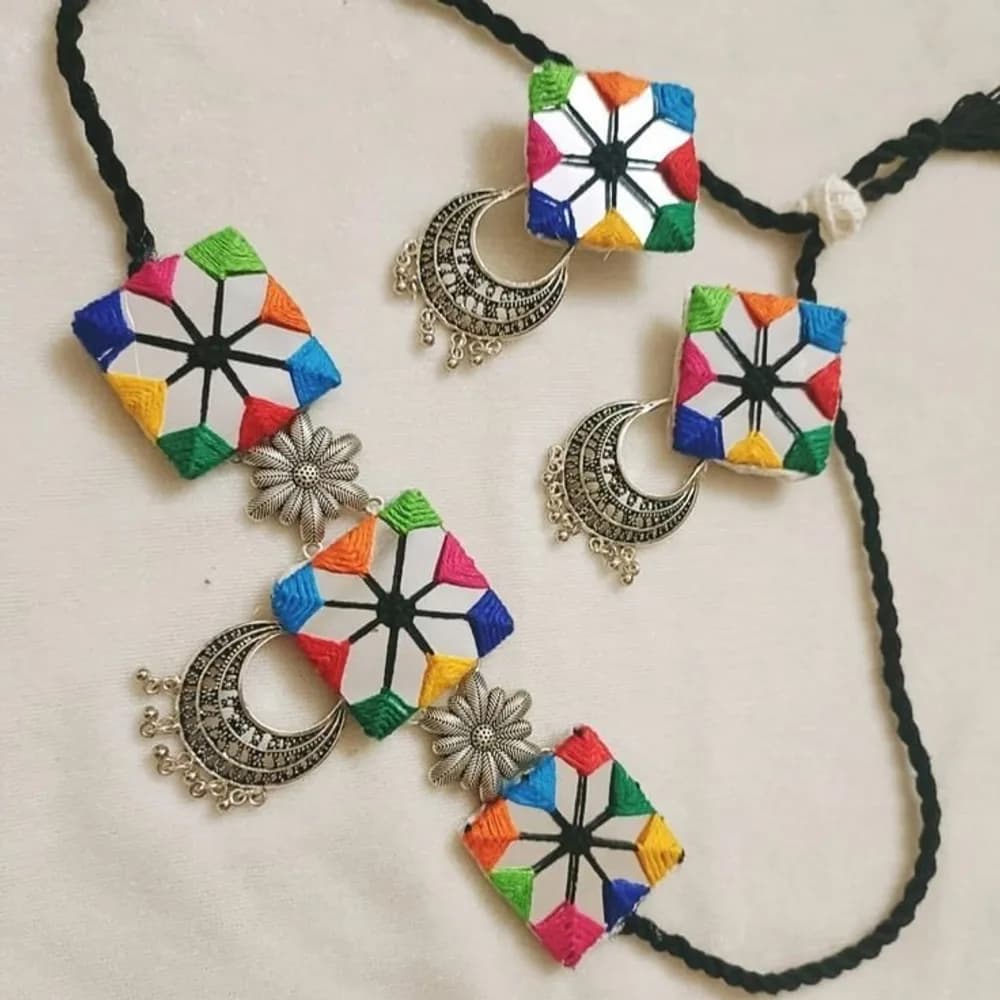
Mirror-work jewellery, also called abhla jewellery, is made by stitching small mirrors into colourful thread embroidery on a fabric base, then finishing it with a cord tie and sometimes bells, coins or shells. It uses the same technique as the mirror-work on Gujarati chaniya cholis, which is why it is the jewellery most closely tied to garba.
Abhla is the Gujarati word for these small mirrors, and abhla bharat is the embroidery that holds them. Traditionally each mirror was a small piece of silvered glass held in place not with glue but by a ring of stitches worked around its edge: the stitching both frames the mirror and stops it falling out. The craft is strongest in Kutch and across Saurashtra, where different communities have their own stitches and motifs, and it turns up on skirts, blouses, quilts, bags and the torans hung over doorways.
Mirror-work jewellery takes that textile and wears it at the neck, wrist or waist. It is fashion jewellery rather than heirloom craft, and it belongs to Navratri the way a jhumka does: it is part of the picture most people have of garba in Gujarat.
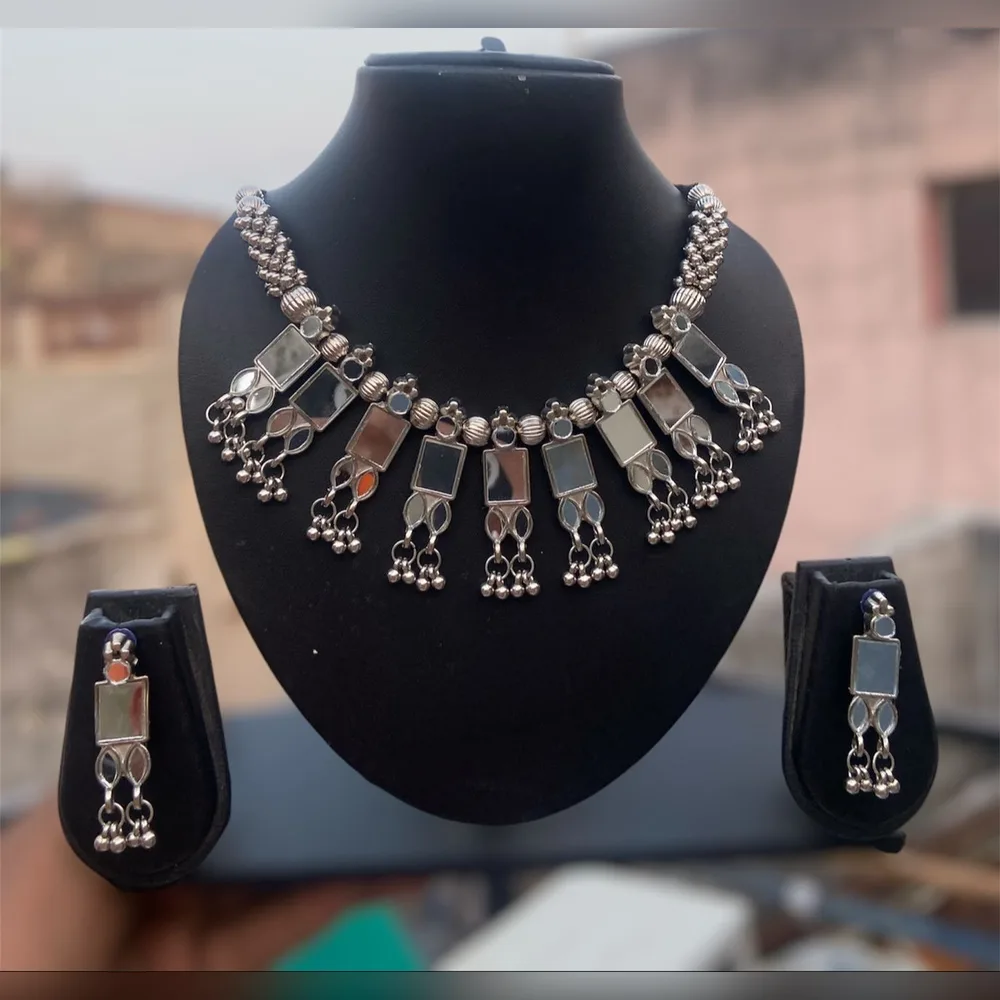
Our Abhla thread and mirror necklace set is the direct version: hand-worked thread and mirror on a fabric base, tied with a knotted cord, with matching earrings. Each colour is its own design rather than one design dyed eight ways. The multicolour has square motifs and oxidised chandbali earrings, the yellow carries cowrie shells, the white has rainbow triangles, and the red pairs a bandhani print with cowries. The Aaina mirror choker set comes at mirror-work from the metal side: an oxidised choker of rectangular mirror plates with bell drops, plus matching mirror drop earrings. At ₹499 it is the least expensive set in the store.
Thread jewellery or metal: which is better for garba?
Neither is better across the board. They behave differently once the dhol starts, and the differences matter over three or four hours of dancing.
| Thread and fabric | Oxidised metal | |
|---|---|---|
| Weight | Lighter for its size, though coins, bells and medallions add weight back | Varies widely; carved kadas and large pendants are heavy |
| Against the skin | Soft and flexible; moves with the neck | Rigid; a choker's edge can rub after a few hours |
| Sound | Silent on its own; bells and coins add the chime | Clinks where parts touch; ghungroo makes it ring |
| Sweat | Absorbs it, dries slowly and can stain | Sits on the surface; wipe it off the same night |
| Colour | Carries colour itself, so it can match a Navratri day exactly | Neutral grey-black; works with every colour |
| Water | Never wet it | Avoid it; pat dry at once if splashed |
| Best with | Plain chaniya choli, kediyu or kurta | Mirror-worked and printed outfits |
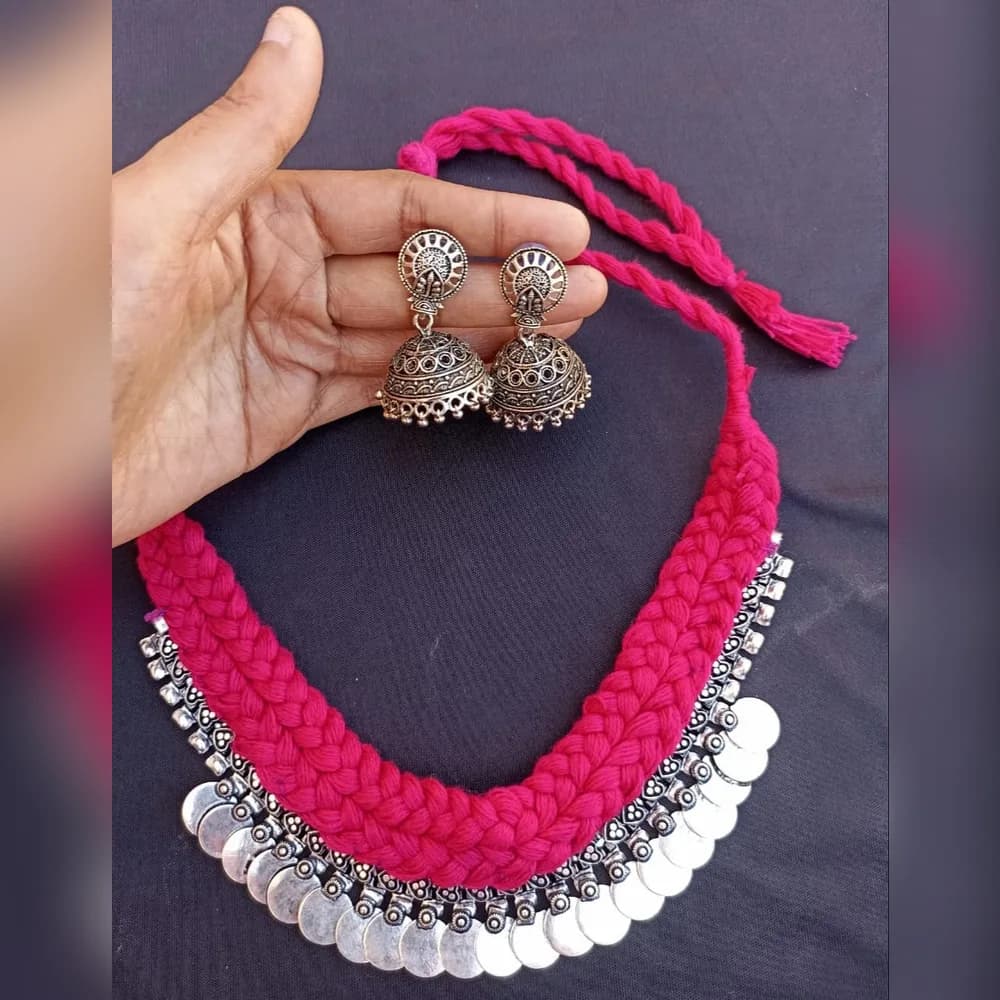
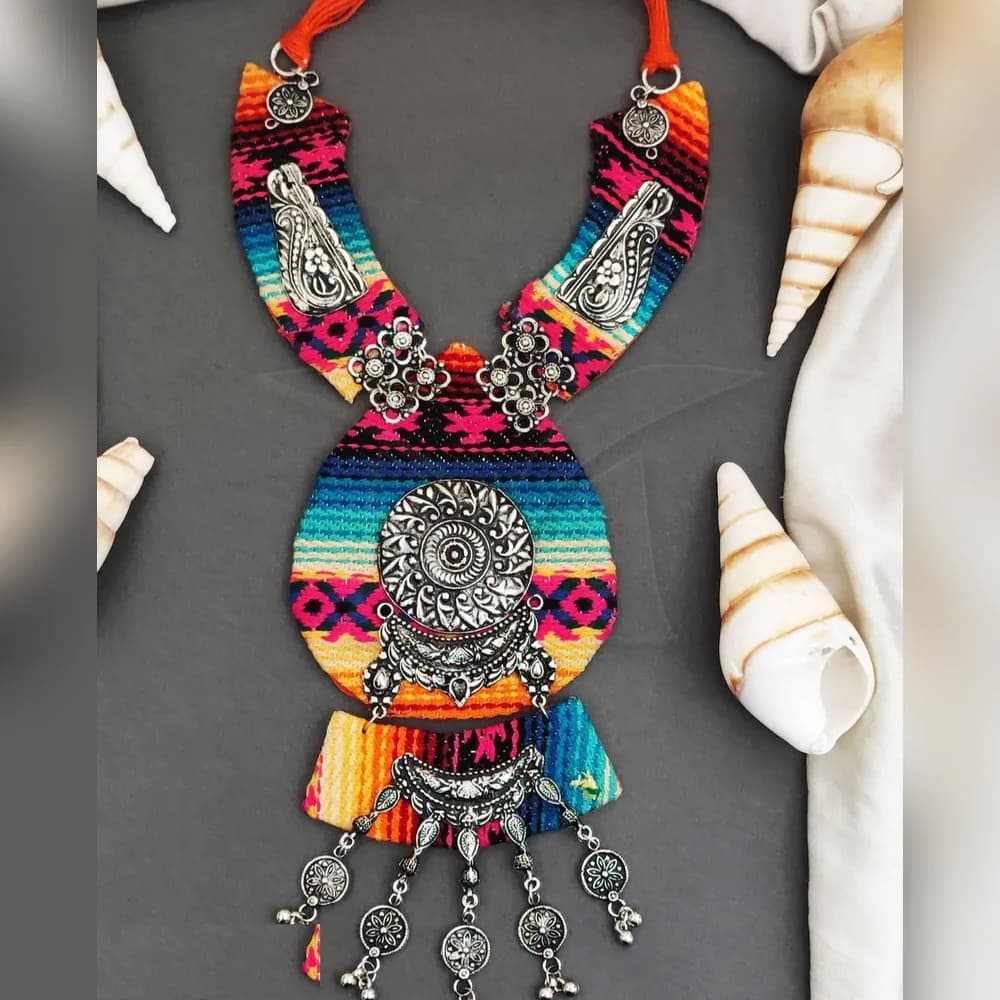
Weight is the point people get wrong. Fabric is light, but a thread necklace is rarely only fabric. The Rangeela fabric thread necklace carries oxidised medallions, a large round pendant and coin and bell drops, and is listed at about 92 g. The Sikka coin thread choker set is a thick braided thread choker hung with a fringe of oxidised coins, closed with a tie cord and sold with matching oxidised jhumkas, in pink or black. Read the weight on the listing where one is given, rather than assuming thread means light.
Sound is the other real difference. Thread is silent, so on a thread piece the chime comes from whatever hangs off it: the Sikka coins, the small bells on some Abhla designs, the bell drops on Aaina. If you want a quiet neck and a ringing wrist, that is easy to arrange with the Toran kada further down.
Matching mirror-work jewellery to the Navratri 2026 colours
Because each Abhla colour is its own design, it can match a Navratri day more closely than oxidised metal can. Navratri 2026 runs from Sunday 11 October to Monday 19 October, and this is how the designs line up with the commonly followed colour list.
| Day and date | Colour | Abhla design | Other mirror and thread picks |
|---|---|---|---|
| Day 1, Sun 11 Oct | Orange | Multicolour | Kesar kamarbandh in Orange Black Pompom |
| Day 2, Mon 12 Oct | White | White (rainbow triangles) | Aaina mirror choker; Toran kada in White Pink |
| Day 3, Tue 13 Oct | Red | Red (bandhani with cowrie) or Maroon | Sikka choker in black |
| Day 4, Wed 14 Oct | Royal Blue | Royal Blue | Toran kada in Blue Green |
| Day 5, Thu 15 Oct | Yellow | Yellow (cowrie shells) | Toran kada in Yellow Pink |
| Day 6, Fri 16 Oct | Green | Green | Toran kada in Blue Green |
| Day 7, Sat 17 Oct | Grey | Multicolour or White | Aaina mirror choker; Sikka choker in black |
| Day 8, Sun 18 Oct | Purple | Purple | Aaina mirror choker |
| Day 9, Mon 19 Oct | Peacock Green | Green or Royal Blue | Toran kada in Blue Green |
If you are buying one piece for all nine nights, choose the multicolour Abhla design or the Aaina choker. Multicolour thread reads as ornament rather than as a colour that has to match, and Aaina's silver-white mirrors sit with all nine. The maroon design is the spare: it isn't on the list, but it is the one to pick if your festival wardrobe runs to deep reds and wines. For a complete look on a budget, see a full Navratri look under ₹1,500.
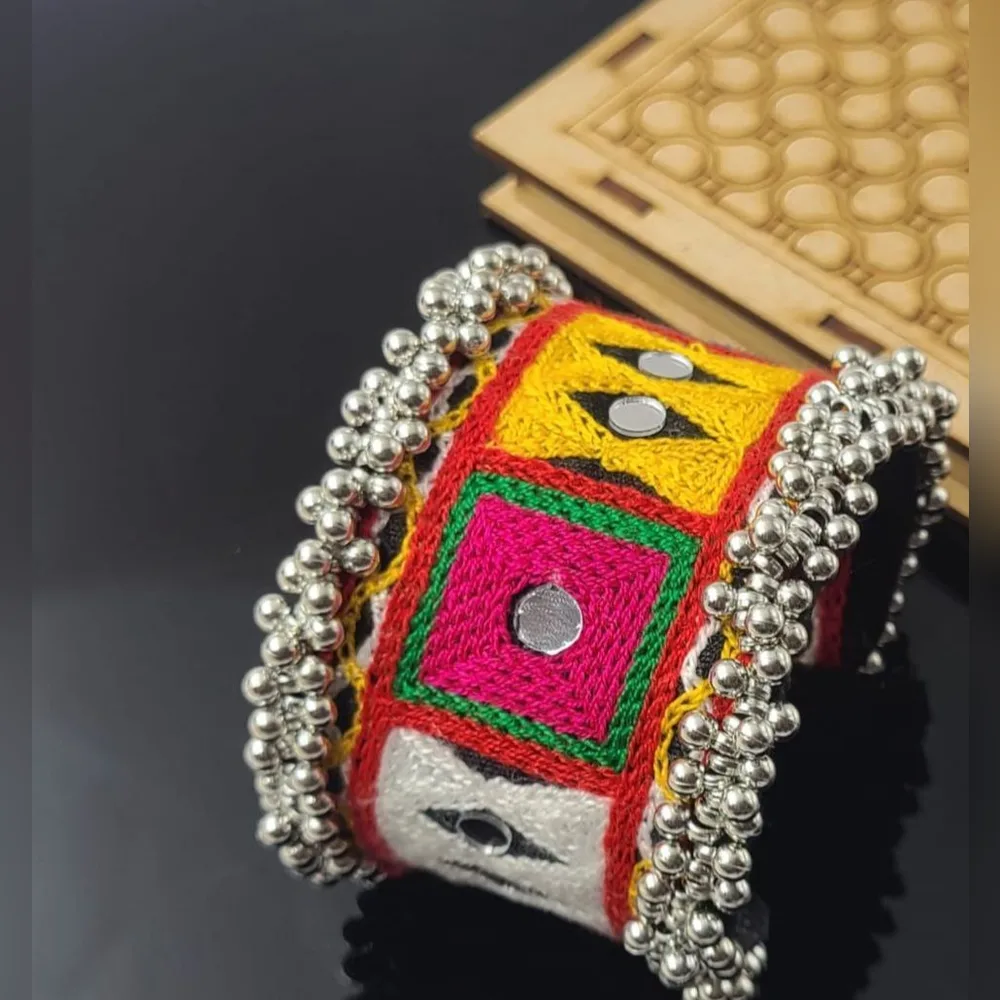
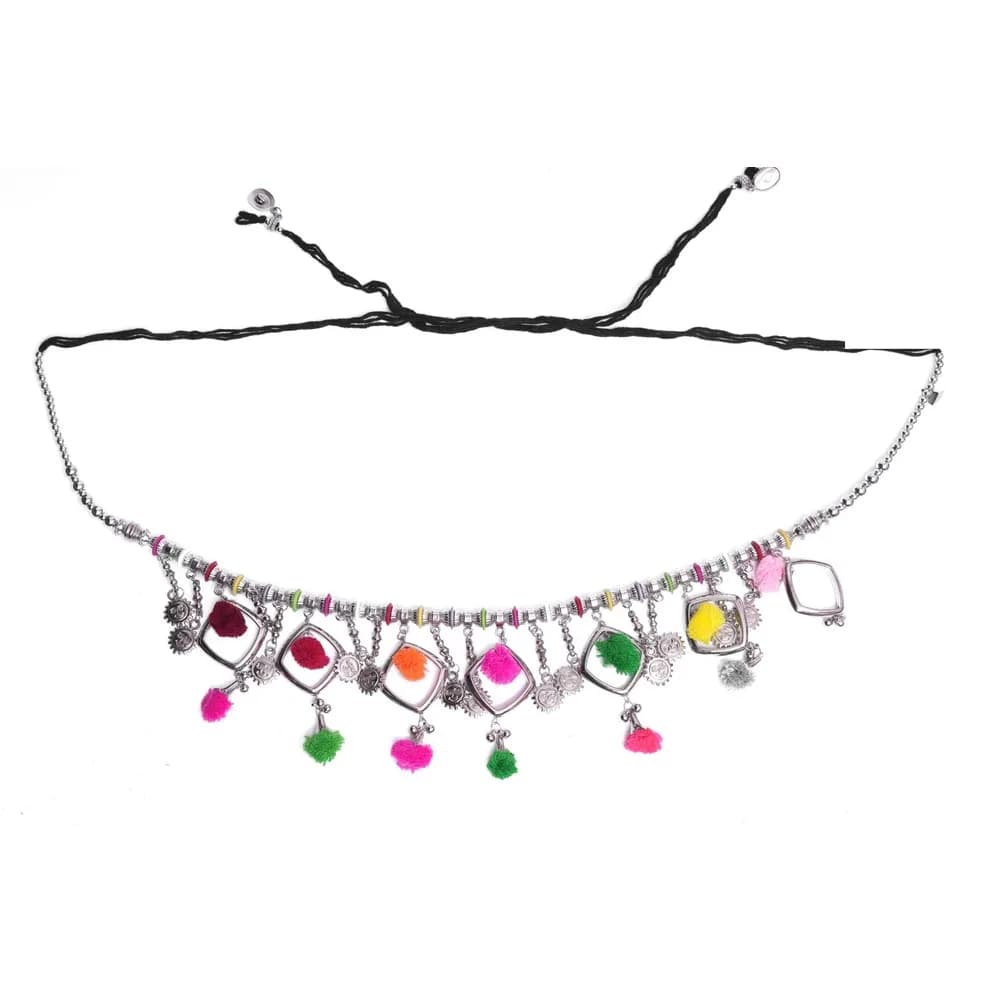
Mirror and thread don't have to stop at the neck. The Toran thread-work ghungroo kada is a wide kada with a band of colourful thread embroidery and small mirrors, edged top and bottom with rows of oxidised ghungroo bells that chime with every clap. It is sold singly, in one standard size and five designs. The Kesar pompom kamarbandh takes the same palette to the waist: an oxidised waist chain on a thread tie, hung with drops, in designs including Mirror Pompom and Multicolour Tassel. How to wear one is in our kamarbandh guide.
Mirror and thread beyond the neck
Wearing and caring for thread and mirror jewellery
Three styling rules
- Mirror on mirror cancels out. A heavily mirror-worked chaniya choli with a mirror-work necklace gives the eye nowhere to rest. Pair thread-and-mirror pieces with a plain or lightly printed choli, and keep plain oxidised metal for the heavily mirrored ones.
- Check the neckline. Sikka and Aaina are chokers and need open skin to sit on. Over a high-necked kediyu or a closed kurta, a longer fabric piece like Rangeela lies better. Our chaniya choli neckline guide goes through it shape by shape.
- Tie cords with a double knot. A cord tie is adjustable, which is useful, but a bow works loose in a fast round. Tuck the ends under the knot.
Care: the never-wet rule
- Never wet thread jewellery, not to wash it and not to spot-clean it. Water can lift colour from the thread and let metal parts mark the fabric.
- Perfume first, jewellery after. Fabric absorbs scent and holds it against any metal it touches, so let perfume dry before the piece goes on.
- Air it the same night. After garba, lay the piece flat in the shade for twenty to thirty minutes so sweat can dry out of the thread before it goes into a pouch. No sun, heater or hair dryer.
- Brush, don't rub. A soft, dry brush lifts dust from embroidery. Rubbing a cloth over mirrors and stitches can pull threads loose.
- Store flat and separate. Give each piece its own pouch, away from hooks and clasps that snag thread, and don't wind cord ties tightly.
Oxidised parts, such as coins, bells and the Aaina plates, need only a dry wipe. The full routine is in how to clean oxidised jewellery and on our jewellery care page.
Frequently asked questions
What is abhla jewellery?
Abhla jewellery is made with abhla, the small mirrors used in Gujarati embroidery. The mirrors are stitched into colourful thread on a fabric base, and the piece is usually finished with a cord tie and sometimes bells, coins or cowrie shells. It is worn mainly for Navratri and garba, often with a chaniya choli or kediyu.
Is mirror-work jewellery the same as Kutchi jewellery?
Not exactly. Mirror embroidery is strongly associated with Kutch and Saurashtra, so thread-and-mirror jewellery is often called Kutchi. Strictly, Kutchi describes where and by whom a piece was made, while mirror-work describes the technique. Ours is mirror-work in the Gujarati style, and we don't describe it as made in Kutch.
Can thread jewellery be washed?
No. Never wet thread or fabric jewellery, even to spot-clean it, because water can lift colour from the thread and let metal parts mark the fabric. Brush dust off with a soft dry brush, let sweat dry out by laying the piece flat in the shade, and keep perfume away from it.
Why are cowrie shells used in Navratri jewellery?
Cowrie shells, or kodi, were used as small change in many parts of India and are still linked with prosperity and the goddess Lakshmi. They are a traditional decoration on Gujarati and Rajasthani textiles, so they suit garba outfits. Being natural shells, each one varies slightly in size and shade.
Which mirror-work necklace goes with every Navratri colour?
A silver-white mirror piece or a multicolour one. The Aaina mirror choker set, with rectangular mirror plates on an oxidised choker, works with all nine colours of Navratri 2026, and multicolour thread reads as ornament rather than as a colour to match. Keep single-colour designs for their own day.
Shop this guide
Pieces mentioned above
Thread Necklace Sets
Abhla Thread & Mirror Necklace Set
Oxidised Choker Sets
Aaina Mirror Oxidised Choker Set
Kada
Toran Thread-Work Ghungroo Kada
Thread Necklace Sets
Sikka Coin Thread Choker Set
Statement Necklaces
Rangeela Fabric Thread Oxidised Necklace
Kamarbandh