Styling
Stacking Bracelets and Bangles Without Overdoing It
Odd numbers, one texture change, one wrist. Most stacking advice is more complicated than it needs to be.
Updated 3 min readRenu Ornaments
One wrist
The first decision is which wrist, and the answer is: one of them. Traditional Indian dressing often loads both — full sets of bangles on each arm — and that is a specific, complete look. What doesn't work is a half-hearted version on both sides.
For contemporary dressing, put everything on one wrist and leave the other bare or wear only a watch. It reads as a decision.
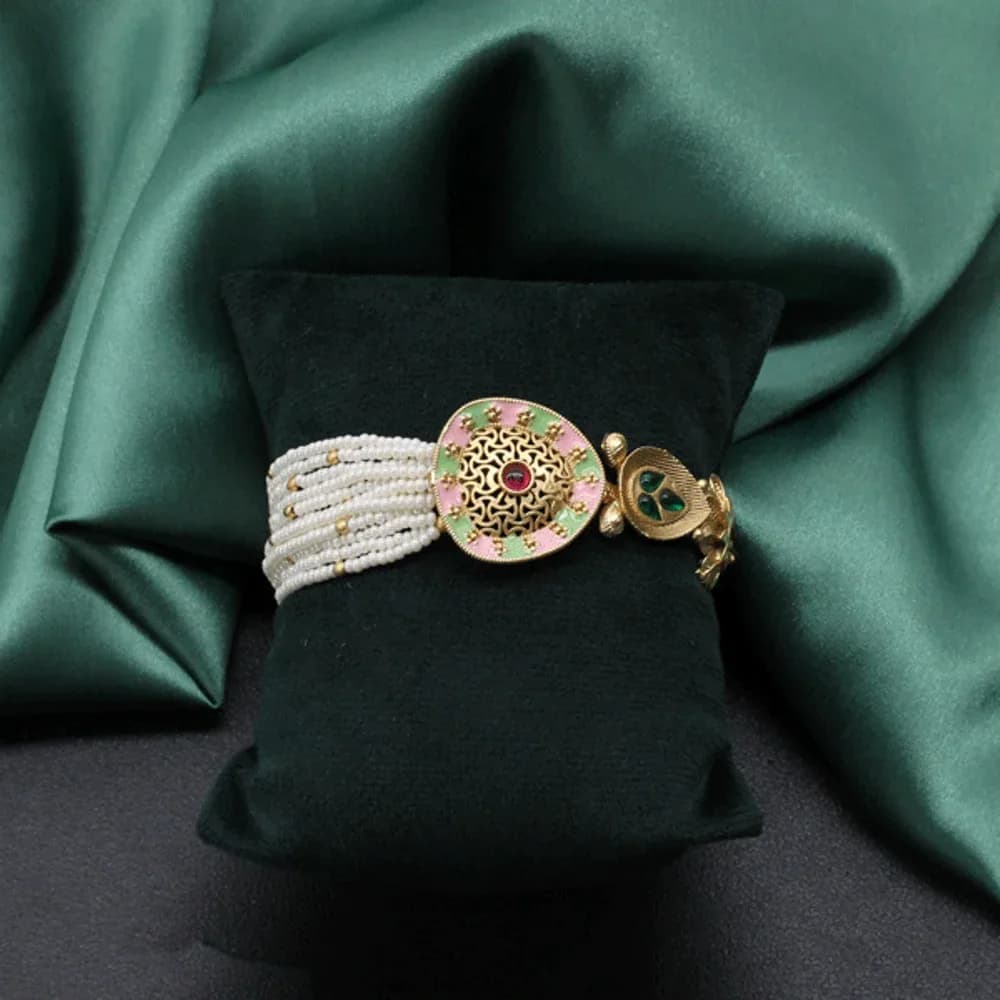
The bracelet in our edit
The counting rule
Odd numbers look more natural than even ones — three pieces, or five. Two identical bangles read as a pair that is missing something; three read as a stack.
| Stack size | Effect | Good for |
|---|---|---|
| 1 bracelet | Quiet, everyday | Office, daily wear, Western outfits |
| 3 pieces | Considered, still light | Family functions, festivals, daytime events |
| 5+ pieces | Full traditional | Weddings, garba, Karva Chauth, Teej |
Change one thing, not three
The most reliable stacking principle: keep everything consistent except one variable.
- Same metal tone, different widths. Three gold-toned bangles of increasing width. Clean and easy.
- Same width, different textures. A smooth bangle, a beaded bracelet, a textured one — all similar in scale.
- Same texture, one colour accent. Plain bangles with a single meenakari piece in the middle of the stack.
What breaks a stack is varying metal tone, width, texture and colour all at once. Then there is no through-line and the eye reads it as a pile.
Where a beaded bracelet fits
A pearl-beaded bracelet is the most useful piece in a stack of rigid bangles, for a specific reason: it moves. Rigid bangles sit in a fixed relationship to each other; a strung bracelet drapes and shifts, which stops the stack looking like a solid cuff.
Place it in the middle of the stack rather than at either end — that way the softer texture is framed rather than left dangling at the edge. On why pearls sit so well against enamel, see pearls and meenakari.
Comfort and practicality
- Stack on your non-dominant wrist. Bangles that clatter on a desk or a steering wheel get taken off within an hour.
- For a long function, fewer and heavier beats many and light — sheer count is what causes wrist fatigue.
- Rigid bangles rub against each other and against a watch. If you're wearing a watch, keep two fingers of space.
- Take a beaded bracelet off before mehendi. Wet paste and beads is a combination you only make once.
Frequently asked questions
How many bangles should I wear?
Three on one wrist is the safe answer for most occasions. For traditional festive dressing there is no upper limit; for everyday wear, one or three.
Can I mix pearl and metal bracelets?
Yes — it is one of the better combinations, because the textures differ enough to read as intentional. Keep the metal tone consistent across the stack.
Should bracelets match my necklace?
Match the metal tone and the general style. An exact design match across every piece can look like a boxed set rather than a personal choice.
Which wrist should I wear a bracelet on?
Your non-dominant wrist, for comfort and to reduce wear. If you wear a watch, put the stack on the other side rather than crowding it.
Shop this guide